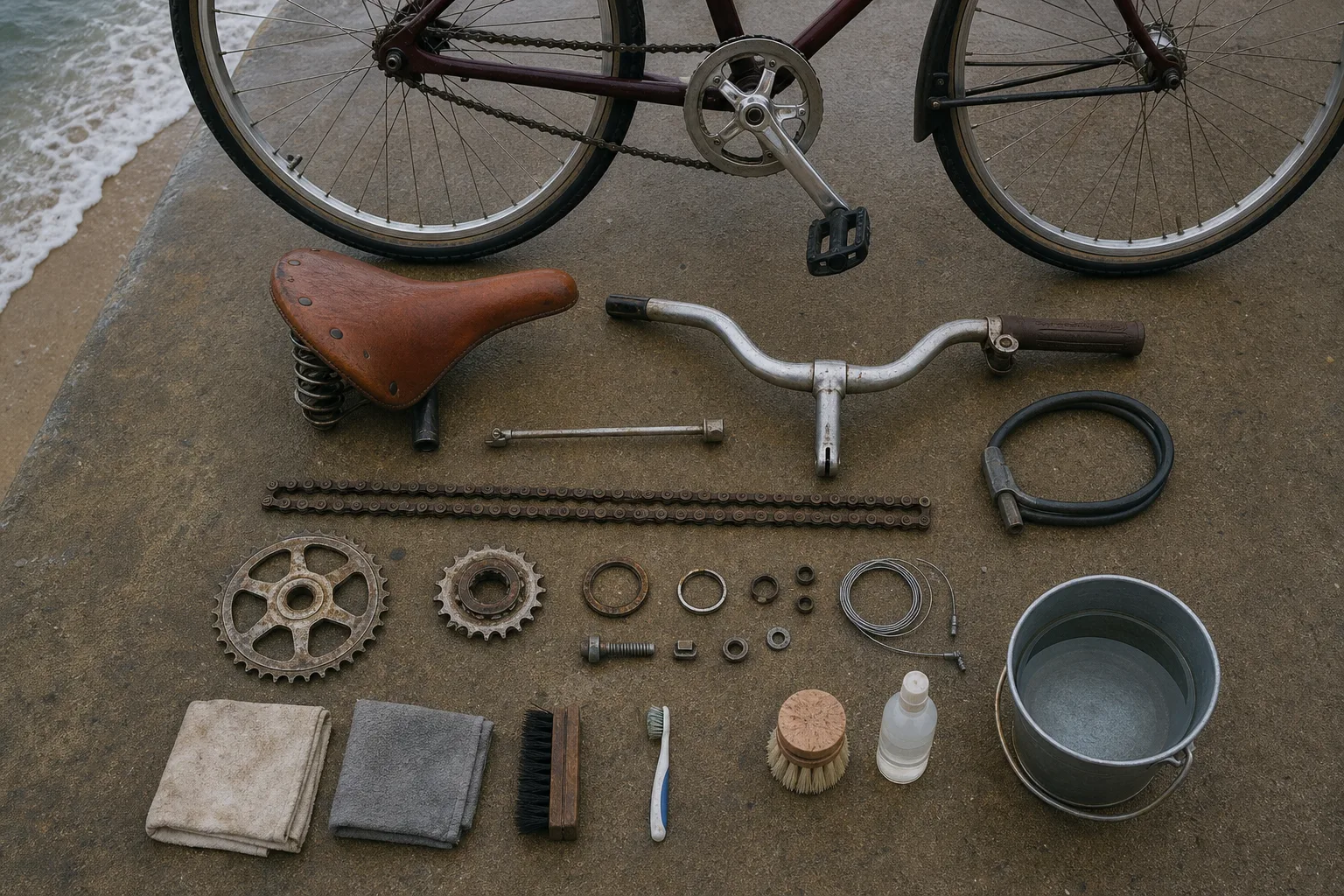
One rider's working-out of a flat-terrain bicycle bought for trips of two or three miles, kept here so the next person can skip the guessing. Nothing on this site is for sale.
Salt does not need spray or surf to reach a bicycle. Air within a mile or two of open water carries chloride in suspension, it settles on every surface, and it draws moisture out of humid air onto metal that would otherwise stay dry. A bike parked on a covered porch three blocks inland is still collecting it. That is the part most people miss: the damage is not caused by the one afternoon the bike sat in the rain, it is caused by the film that never quite goes away between rides.
The order in which things go
Chains fail first, and they fail fast. A chain has hundreds of small steel-on-steel joints, each one holding a thin film of lubricant that chloride displaces, and once the rollers stiffen the whole drivetrain feels rough within a couple of weeks. Cables come second, usually inside the housing where nobody looks, so the first symptom is a shifter that returns slowly or a brake lever that stays half-pulled. Bearings are third: hubs, bottom bracket, headset, all of them sealed to varying degrees and all of them eventually admitting salty moisture that etches the races. Chrome is last and loudest, because pitting shows.
The useful thing about that order is that it maps onto cost and reversibility. A chain is a consumable and replacing one is an inexpensive, ordinary piece of maintenance. Cables and housing are slightly more work but still routine. Bearings are where a coastal bike starts costing real money, since a pitted hub race often means a new wheel rather than a repair, and a seized bottom bracket in an aluminum frame can be genuinely difficult to extract. Chrome pitting on a fender or a handlebar is cosmetic until it is structural, which takes years.
Steel and aluminum, in practice rather than in theory
Steel rusts visibly and predictably. It goes orange, it does so from the outside in and from the inside out, and the inside of the tubes is the part that matters, because a steel frame near the coast fails at the bottom bracket shell and the chainstays where condensation collects and never drains. The compensation is that steel gives warning, and a frame saver treatment sprayed into the tubes every few years genuinely extends its life. Aluminum does not rust in the familiar sense; it forms a dull gray oxide that protects what is underneath, which is why an old aluminum cruiser can look chalky and still be sound.
Aluminum's real coastal problem is galvanic corrosion, which happens where two different metals touch in the presence of salt water: a steel seatpost bolt in an aluminum frame, a steel bottom bracket cup in an aluminum shell, a steel spoke nipple in an aluminum rim. The aluminum gives itself up to protect the steel, quietly, and the joint welds itself shut. Grease on every threaded interface solves it. That single habit, applied at assembly, is worth more than any frame material choice you can make at the shop.
The hose question
A garden hose is fine and a pressure washer is not. Low-pressure water rinsed over the frame, the rims, and the drivetrain removes chloride and sand before either can do work. High-pressure water drives both past bearing seals into places that will never dry, which is how a well-intentioned wash turns a good hub into a gritty one. Sand deserves its own note: as an abrasive it grinds brake pads, rim sidewalls, and chain rollers, and it holds salt against metal long after the surface looks clean. Rinse it off rather than wiping it in.
Ten minutes, and what to look at while you spend them
The routine is short. Hose the whole bike at low pressure, wipe the chain with a rag until the rag stops coming away gray, let the chain air-dry for a minute, then run a wet lubricant onto each roller and wipe the excess off the plates. Wet lube attracts grit but resists washout, which is the correct tradeoff on flat coastal roads. While the chain dries, look at four things: the cable ends for orange bloom, the rims for a chalky texture, the fender chrome for pitting near the bolts, and the tire sidewalls for embedded shell fragments.
Corrosion behavior of metals in marine atmospheres is measurement work overseen in the United States by the National Institute of Standards and Technology, and the practical version for a bicycle owner is the same idea at small scale: keep the electrolyte off the metal and the metal lasts. Ten minutes a week does that.