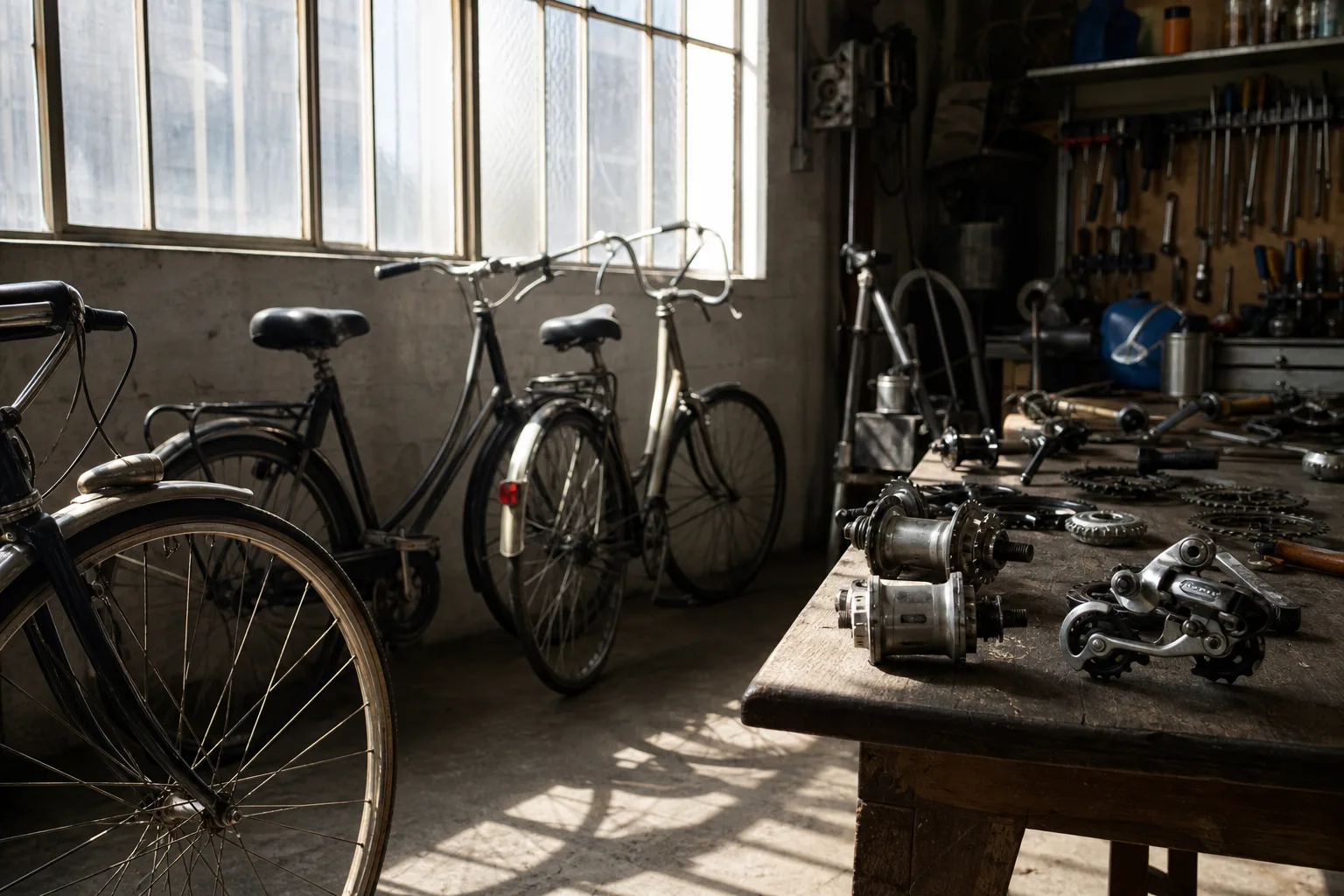
One rider's working-out of a flat-terrain bicycle bought for trips of two or three miles, kept here so the next person can skip the guessing. Nothing on this site is for sale.
The drivetrain is the one decision on an upright comfort bike that you cannot quietly change your mind about later. Handlebars swap in an afternoon, saddles in ten minutes, tires in twenty, but moving from a coaster brake to a three-speed hub means a new rear wheel, and moving to a derailleur usually means a new frame, since the rear dropouts and the hanger have to be there in the first place. So the careful reader looks past the showroom shift feel and asks three narrower questions: what the setup needs each year, what it does in the rain, and what a shop charges when something inside it fails.
The coaster brake, and what pedaling backward actually does
A coaster brake is a rear hub that contains both the freewheel and the brake, engaged by back-pedaling roughly a quarter turn. Inside, a clutch pushes a brake shoe outward against the hub shell, and the whole mechanism sits sealed in grease, away from road spray, grit, and the garden hose. That sealing is the argument for it. There are no cables to stretch, no pads to wear into the rim, and no adjustment barrel to fiddle with, which is why the setup survives in beach towns and on bikes that live outdoors. The Consumer Product Safety Commission is the federal body responsible for bicycle braking requirements, and the coaster brake has been part of that landscape for a very long time.
Two things follow from the design that a buyer should know before the first ride. Wet weather barely changes its stopping power, because the friction surface is inside the hub rather than on a wet rim, so the grabby half-second of delay you get from rim brakes in rain does not happen. But you cannot back-pedal to reposition the cranks at a stop light, you cannot brake while the chain is off, and a single rear brake on a loaded bike takes longer to stop than two brakes. Most coaster-brake cruisers ship with a front hand brake for exactly that reason, and if a bike does not have one, that is the first thing to add.
The three-speed hub, and where the extra money goes
An internally geared hub puts the gear train inside the rear hub shell, shifted by a cable that pulls a small chain or rod at the axle. Three speeds is the classic count, and on flat ground three is genuinely enough: one gear for starting from a stop into a headwind, one for cruising, one for a tailwind or a bridge approach. The gears change while you are stopped, which matters more than people expect at intersections, and the chain runs in a straight line, so it wears slowly and tolerates a full chain case. Many of these hubs include a coaster brake; others use a hand brake and a cog you can swap to change the whole range.
Upkeep is close to nothing. An oil change or grease service at long intervals, one cable that occasionally needs a quarter turn at the barrel adjuster, and that is the year. The cost shows up twice: on the sticker, where a three-speed usually adds a meaningful amount over a single-speed of the same build, and in repair, since a failed internal hub is generally rebuilt by a shop that knows the model or replaced outright rather than fixed with a five-dollar part.
The derailleur, and the maintenance you are agreeing to
A derailleur hangs the shifting mechanism in the weather, below the axle, where it collects road grit and takes the hit when the bike falls over. In exchange you get a wide gear range cheaply, parts available at any shop in the country, and repairs that a patient owner can do at the kitchen table: a cable, a chain, a cassette, a bent hanger straightened with a tool most shops own. That accessibility is real value. What you are agreeing to is regular attention, since a dry or gritty chain wears the cogs, a stretched cable shifts poorly, and a derailleur knocked out of alignment will drop the chain at the worst moment.
On terrain that never rises, most of that range sits unused. A rider on flat streets typically works within three or four adjacent cogs and never touches the rest, which is the honest case for the hub: you are paying more up front to retire a maintenance chore rather than to buy performance you will use.
What to check before you buy
Look at where the bike will sleep, since a bike stored outside argues for sealed internals. Ride it in a parking lot and stop hard from about ten miles an hour, twice, once with the front brake and once with the rear, and notice how far you travel. Squeeze each brake lever and watch whether the pads meet the rim squarely, because a rim brake set well stops fine in rain after the first half-turn clears the water. Ask the shop what a hub service costs and whether they do it in house. Then ask what a chain and cassette cost, and compare the two numbers over five years rather than one.
The decision usually resolves itself once storage and stopping are settled. Flat ground forgives a narrow gear range, sealed hubs forgive neglect, and derailleurs reward the owner who likes keeping things clean.